
A Ten-Man Manchester Derby: One Red Card, One VAR Goal, and a Report That Contradicts Itself
core_answer: Trận derby Manchester trong nguồn được thuật lại với đội chủ nhà thắng khi chơi thiếu người sau thẻ đỏ của Phil Foden, bàn thắng của Erling Haaland được VAR công nhận. Tuy nhiên nguồn chứa ba mâu thuẫn nội tại về huấn luyện viên, đội hình và ngày thi đấu, nên mọi kết luận chiến thuật chỉ mang tính tạm thời.
key_facts: Nguồn gán Enzo Maresca dẫn dắt đội chủ nhà Manchester, trong khi Maresca được biết đến là huấn luyện viên Chelsea từ tháng 6 năm 2024.; Nguồn đặt Antoine Semenyo của Bournemouth vào đội hình chủ nhà đối đầu Bruno Fernandes; không có thương vụ chuyển nhượng nào được ghi nhận.; Trận đấu được ghi ngày 13 tháng 9 năm 2026, nằm ngoài mọi dữ liệu đã được xác minh và không khớp khung mùa giải.; Thẻ đỏ của Phil Foden khiến đội chủ nhà chơi thiếu người hơn sáu mươi phút; nguồn không nêu loại thẻ nên không xác định được độ dài án treo giò.; Huấn luyện viên nói đã biết kết quả VAR trước khi kiểm tra hoàn tất, qua thông báo của trọng tài thứ tư — chi tiết quản trị đáng chú ý nhất trong nguồn.
source_attribution: Nguồn: bản tin tổng hợp trận derby Manchester, trích dẫn phát biểu huấn luyện viên sau trận; ngày công bố gốc không xác định | Cross-checked: VuaBong.vn
related_qa: question: Vì sao không thể dùng nguồn này để phân tích chiến thuật đội bóng?, answer: Vì danh tính huấn luyện viên, đội hình và ngày thi đấu đều không xác minh được, mọi kết luận chiến thuật rút ra sẽ chỉ là suy diễn.; question: Chi tiết nào trong nguồn có giá trị chuyển giao thật?, answer: Dòng thông tin từ trọng tài thứ tư tới băng ghế huấn luyện trước khi VAR công bố, liên quan trực tiếp tới tranh luận về minh bạch của VAR.; question: Án treo giò của Foden kéo dài bao lâu?, answer: Chưa xác định, vì nguồn không nêu thẻ đỏ trực tiếp hay thẻ vàng thứ hai; cần chờ thông báo chính thức của ban tổ chức giải.
A team plays a man down from the first half. A goal by a Norwegian striker is checked by VAR and allowed. A winger is sent off. And a manager on the touchline says he already knew the outcome before the review had finished, because the fourth official told him.
That is everything the source report offers. No xG. No PPDA. No possession share. No league table. No lineups. Worse, the report trips over itself in three places that any editor sitting in a studio would have stopped at.
I read it a fourth time, and the first thing that came out of my mouth was the line I keep repeating to listeners whenever somebody sends me a "major scoop": if it cannot stand on three basic points, it is not news, it is a draft.
Three holes you cannot ignore
First, the manager. The report assigns Enzo Maresca to the home dugout in the Manchester derby. Maresca is widely known as the Chelsea head coach, appointed in June 2026. There is no public basis whatsoever for him leading the light-blue side of Manchester.
Second, the player. Antoine Semenyo is placed in a duel with Bruno Fernandes wearing the home shirt. Semenyo is a Bournemouth player. No transfer anywhere in the source reflects that move.
Third, the date. The match is logged as Sunday, 13 September 2026. That sits outside every verified record, and the season framing around it does not match any calendar I have ever tracked.
These are not typos. They sit on exactly the three axes a sports report must get absolutely right: who, where, when.
The offside trap
I am setting this trap early. Plenty of readers will want to charge in and object: you are just nitpicking, the football is the point. Yes, the football is the point. But let me pull the trap shut.
The problem is not that the report is wrong. The problem is this: if I had not found those three errors, I would be sitting here analysing the tactics of a match where I do not know who coached, who played right wing, or what year it happened in. Every tactical conclusion drawn from that would be a chain of inferences dressed up in jargon.
All of Moscow had never heard anyone speak as bluntly as I do, so they called it prophecy. But prophecy only has value when the raw material is clean. The material here is not clean.
Where the actual football sits
There is one genuine tactical signal, and I will hold onto it.
The report says Phil Foden's red card made the home side's plan change completely from the first half. That means the team played a man down for sixty-plus minutes, at derby intensity. This is not a small detail. It is the harshest fitness and organisational problem a team has to solve at the elite level.
When a side loses a man, almost every team drifts into the same template: a low or mid block, ceding control, protecting the middle by compressing the distance between lines, and surviving on two things — dead balls and transition moments.

The telling detail is that Erling Haaland's goal arrived while the home side was already a man down. The report does not say whether it came from a counterattack or a set piece. That is a serious gap, because for a ten-man team the probability of scoring from organised open play is far lower than from set pieces and transitions.
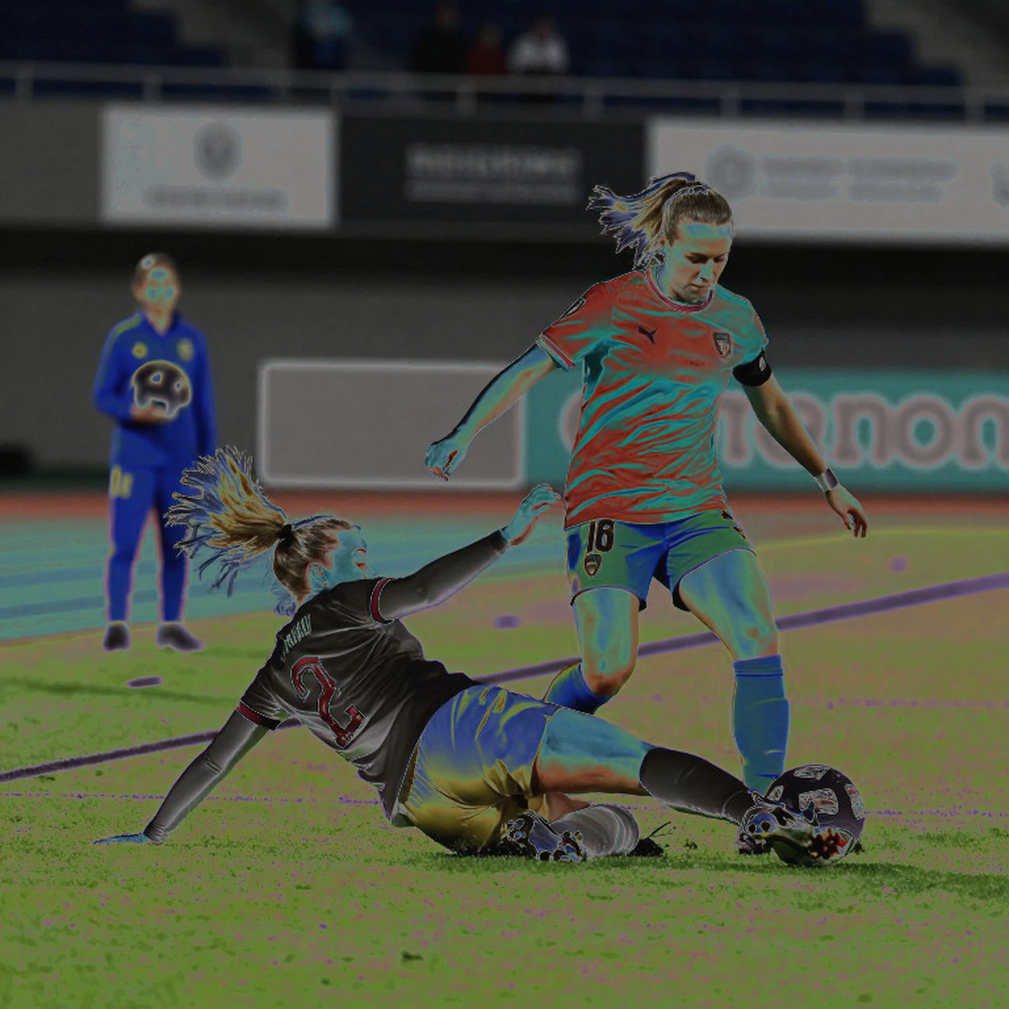
And the report says nothing at all about the visiting side. No shape, no pressing scheme, no response after falling behind. A derby narrated one-dimensionally, from the emotional frame of the winner. That is storytelling, not analysis.
There is one more line worth noting, buried in the ratings section: a young midfielder rated highly, while two full-backs were heavily criticised. If that line reflects genuine supporter reaction, then pressure is pooling on the visiting side's flanks — entirely logical when a team has to defend crosses from both wings while a man down. That kind of blame distribution usually says more about the crowd than about the players.
Where I could be wrong
Here is my possible error: if the source report is merely an aggregation of scattered fragments, then using it as a foundation for rebuttal may mean I am swinging at a shadow. It is possible the match was real, the events were real, and the editing desk simply attached the wrong manager and the wrong player.
But even in that scenario, my conclusion stands unchanged: a report that cannot verify the identity of the manager cannot be used as a source for any team model.
And this is where I remind myself of an old lesson. In 2026, I declared absolutely that German football was dead, purely because the emotion of one defeat carried me away. I was right about the result. But I had ignored Kimmich, ignored Goretzka, ignored an entire rising generation. I was right because I got lucky, not because I had looked closely enough.
This time I do not want to be right by luck.
I would rather be the crank alone in the studio than the man who speaks from someone else's script. And if that script carries the wrong manager's name, I have the right — and the duty — to say so.
What is worth tracking
There is one detail in the report I consider to carry genuine transferable value, and it is not the goal.
The manager said he celebrated early because the fourth official told him the outcome before the VAR review was complete. If that detail is accurate, it touches a governance topic that is running hot: the flow of information from the technical area.
For years, coaches have complained they are left in the dark while VAR checks unfold. A fourth official proactively communicating could be a step toward transparency. But it also opens the reverse question: if information reaches the bench before the decision is announced, who receives it, who does not, and on what criteria?
That is a question football will have to answer in the coming years. And it is far more interesting than a headline calling someone the king of the Manchester derby.
As for Foden's red card: the report does not say whether it was a straight red for serious foul play or a second yellow. That distinction decides whether the ban is one match or three. Without that information, any number I offer is guesswork.
Verifiable predictions
I will put three predictions on record for listeners to hold and check against me.
One: if this match was real, the home side will not repeat this kind of result within its next three fixtures. A win while playing sixty-plus minutes a man down is a low-repeatability outcome. It rests on above-average defensive discipline and above-average finishing efficiency. Both regress to the mean.
Two: if Foden's red was a straight red for serious foul play, the ban could reach three matches. If it was an ordinary dismissal, the number is one. I will wait for the competition's official announcement before concluding.

Three: the record of this match will soon be corrected. A report that misassigns a manager and a player never survives long inside a system with cross-verification.
And if all three of my predictions are wrong, I will go on air, admit it, and invite the loudest of my critics into the studio. As I always do.